The Water District Line Is the Real Price Tag on Los Banos Farmland
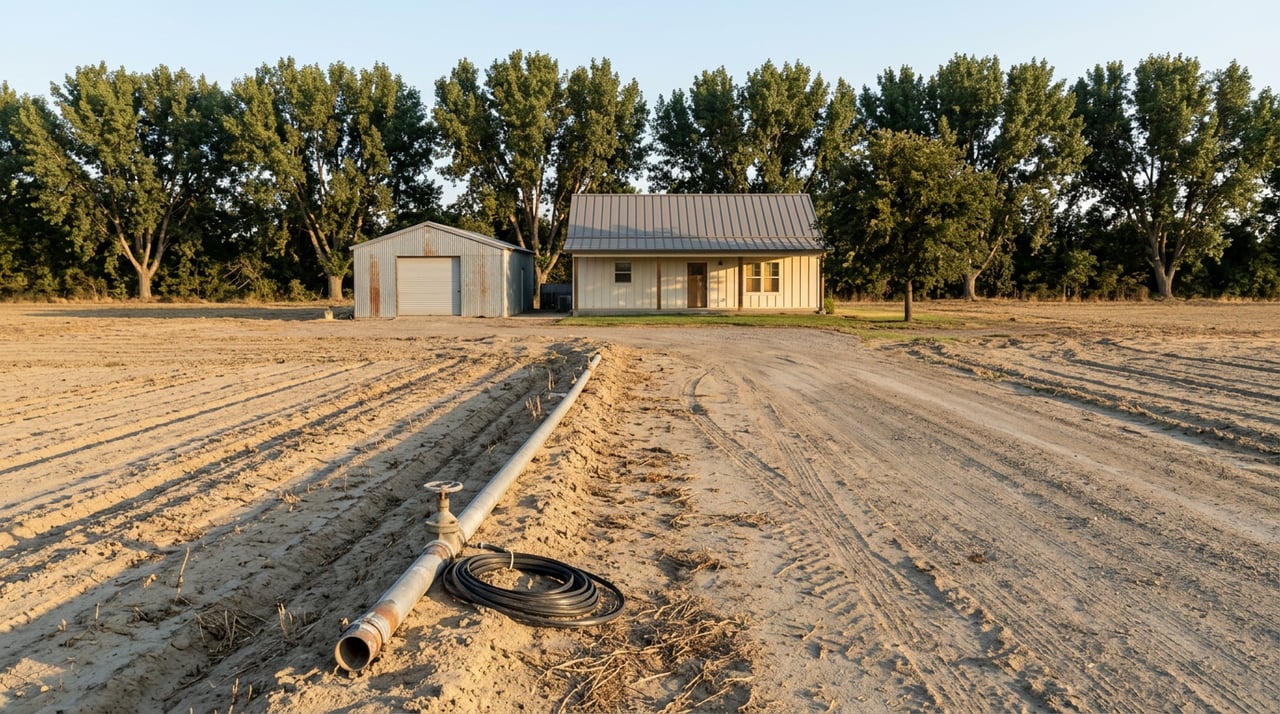
Two parcels came up near Henry Miller Road this year, both close to a hundred acres, both row-crop ground, both priced within a few hundred dollars of each other per acre. On paper they were nearly identical. In practice, one of them belongs to a water system that guaranteed its owner the same water this year that it guaranteed in 1995, and the other belongs to a system that told its owner in February to plan on 15 percent of a normal year, then quietly raised that number four separate times before summer ended. Nothing on the listing sheet explained the difference. You had to know which water district the parcel sat in.
That is the piece of information most farmland buyers, and most heirs settling a family property, never think to ask for first. They ask about soil type, well depth, crop history. Those matter. But near Los Banos, the line that actually prices a parcel runs through paperwork most people have never heard of: the San Joaquin River Exchange Contract.
Start with the volatility, because it is the clearest way to see the split. The Bureau of Reclamation classified 2026 as a non-critical water year, which sounds reassuring. What it meant for most Central Valley Project irrigation contractors south of the Delta was a slow, uneven climb:
| Date | South-of-Delta ag allocation |
|---|---|
| February 26, 2026 | 15% of contract total |
| March 24, 2026 | 20% |
| May 19, 2026 | 25% |
| August 12, 2026 | 28% |
That is four separate federal announcements in six months, each one adjusting the number a farmer had already budgeted around. Reclamation's own reasoning tracked a genuinely strange year: statewide snowpack sat near 59 percent of average in late February, then melted so fast that by mid-May the state's Department of Water Resources was describing snowpack at roughly 12 percent of average, even as reservoirs stayed full from earlier storms. Water managers were making real-time calls on how much of that snowmelt they could capture before it ran out.
Allison Febbo, general manager of Westlands Water District, made the frustration plain when the August increase landed just three percentage points higher than the prior number: "A 3 percent allocation increase this late in the year only underscores the need to modernize California's water management system." Farmers on this side of the ledger spend the whole growing season not knowing, with any real precision, how much water they will actually get.
A few miles away, on land served by the San Joaquin River Exchange Contractors, the calculation looked completely different. Those contractors hold pre-1914 water rights that trace back to Henry Miller of the Miller and Lux cattle operation, who began building diversion canals off the San Joaquin and Kings Rivers in 1871. Los Banos was the headquarters of that old ranch. When the federal government built the Central Valley Project in the 1930s and needed the Exchange Contractors to give up their river diversions in favor of upstream reservoir storage, the two sides struck a deal in 1939: substitute water, delivered instead through the Delta-Mendota Canal, up to 840,000 acre-feet a year, reduced only in years the contract defines as critical. Reclamation's own February 2026 announcement confirmed the arrangement still held: San Joaquin River Exchange Contractors' water supply is based on settlement of claimed senior rights, and the 2026 water year's non-critical classification meant 100 percent of their contract supply, full stop, while their neighbors were still negotiating in single digits.
Locally, that senior-rights guarantee runs through the San Joaquin River Exchange Contractors Water Authority, a joint powers authority headquartered on H Street in Los Banos and formed in 1992 by four member agencies. One of them, the San Luis Canal Company, covers roughly 45,000 acres of farmland specifically between Los Banos and Dos Palos, a private mutual water company dating to 1913 that still serves more than 300 landowners growing alfalfa, cotton, tomatoes, corn and winter forage. Another member, the Central California Irrigation District, covers about 145,000 acres and delivers to over 1,600 farms, many family-held for generations. Together the full Exchange Contractors territory spans roughly 240,000 acres across Fresno, Madera, Merced and Stanislaus counties, from Patterson down to Mendota, with Los Banos sitting inside that footprint.
Federico Barajas, executive director of the San Luis & Delta-Mendota Water Authority, described the standard CVP contractors' initial 2026 number this way: "This low initial allocation of 15% for south-of-Delta agricultural water users is disappointing and concerning for the families and communities in the San Joaquin Valley that depend on CVP water supplies." No one issued a comparable statement about Exchange Contractors land, because there was nothing to complain about. That silence is itself the data point.
Farmland listings around Los Banos usually name the water source directly, and the phrasing tells you almost everything if you know what to look for. Active parcels in the area have been marketed with language like a 1,038.79-acre offering on Turner Island Road described as sitting in "a desirable Exchange Contractors District," a separate 814.8-acre alfalfa property listed within Grasslands Water District, and a smaller parcel off Midway Road south of Henry Miller Road carrying San Luis Water District rights tied to a 276-foot well. Each of those names points to a different allocation reality, and none of them behave the same way in a dry year.
Before treating two similarly priced parcels as comparable, ask for three specific things:
A 2026 industry guide to California land buying put a number on why this matters financially: properties with reliable water access can run 200 to 400 percent higher in cost per acre than comparable dryland, and California farmland overall spans an extreme range, from around 5,000 dollars an acre for pasture to more than 30,000 dollars an acre for irrigated permanent crops. That spread is not random. It is largely the water district line, priced.
For a buyer comparing two Los Banos-area parcels at similar per-acre prices, the Exchange Contractors parcel is very often the better long-term hold, because its water is not renegotiated every few months by federal officials responding to snowpack data. For a seller whose land sits inside that Exchange Contractors footprint, the water history is worth stating plainly in the listing rather than assuming buyers will find it themselves.
For families settling an estate, this is where it gets personal. Inherited farmland near Los Banos often comes with decades of informal knowledge that the water is "good" or "always reliable," without anyone in the next generation knowing why. If the parcel sits within the San Luis Canal Company or another Exchange Contractors member district, that reliability has a specific legal source, a contract from 1939 built on rights from 1871, and it is worth documenting clearly as part of the estate so the next owner, or the next buyer, understands what they are actually holding. If the parcel instead sits on a standard CVP allocation, that is useful to know too, because it changes what kind of crop planning, financing conversation, or eventual sale price makes sense.
None of this shows up in a median price pulled from a portal. It shows up in the water district's name on the title report, which is exactly the kind of detail that separates people who understand Central Valley land from people who are just reading the listing.
Does Exchange Contractors land always cost more per acre than standard CVP land nearby? Not automatically, and soil quality, crop history, and infrastructure still matter. But all else equal, the guaranteed senior water right is a real premium buyers should expect to pay for, not a bonus they stumble into.
What happens to Exchange Contractors water in a genuinely critical year? Their contract allows a reduced annual supply, up to 650,000 acre-feet instead of the normal 840,000 acre-feet ceiling, in years defined as critical. 2026 was classified non-critical, so the full guarantee applied.
Is SGMA relevant even on land with strong surface water rights? Yes. Groundwater sustainability rules apply across the Central Valley regardless of surface water reliability, and a buyer should still confirm which Groundwater Sustainability Agency governs the parcel before assuming unlimited well access.
If you are looking at farmland, rural acreage, or an inherited property near Los Banos and want to understand which water district it actually sits in before you make a decision, Christine Kinsley has spent more than two decades working this exact ground. Let's Connect.
Stay up to date on the latest real estate trends.
Want an agent who'll really listen to what you want in a home? Need an agent who knows how to effectively market your home so it sells? Give me a call! I'm eager to help and would love to talk to you.