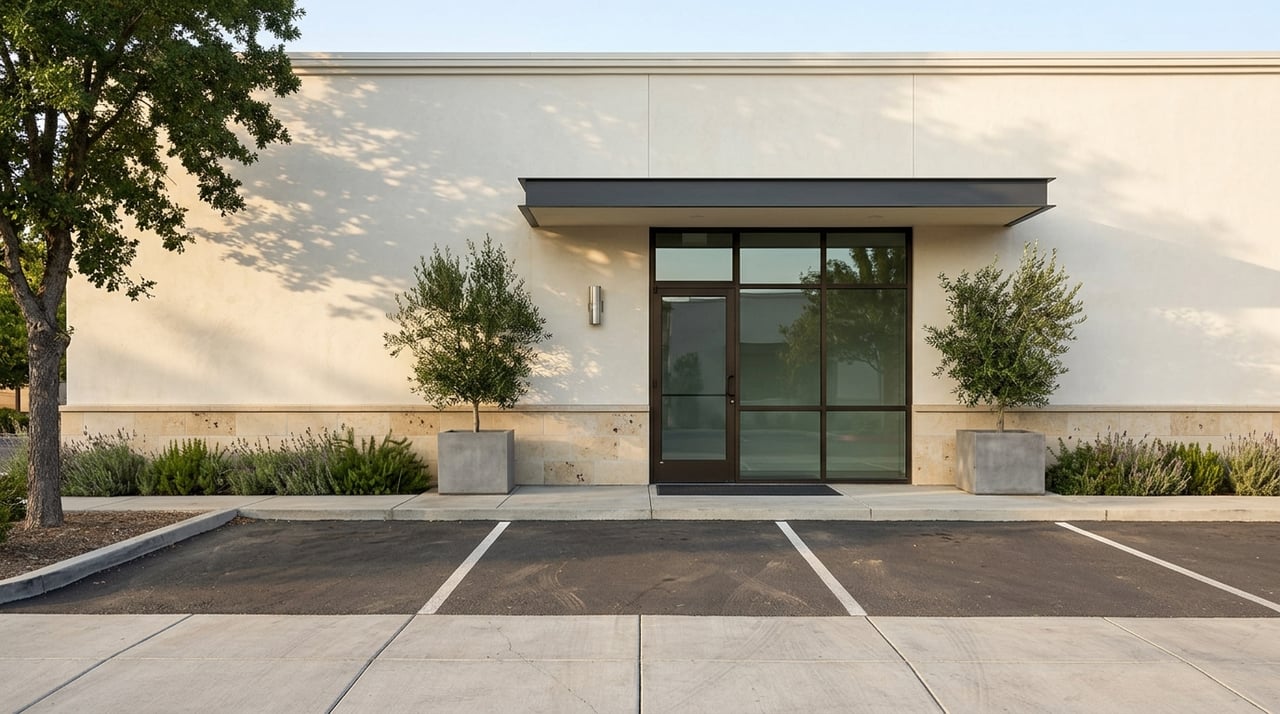
How To Evaluate Commercial Property In Fresno
If you are looking at commercial property in Fresno, it is easy to get pulled in by a strong location or an attractive asking price. But a good commercial deal is about much more than curb appeal. You need to know how the property fits Fresno’s market, what it will really cost to own or occupy, and whether the site supports your long-term plan. Let’s dive in.
Fresno is a major Central Valley market with a large population base, broad consumer activity, and strong transportation connections. The city had an estimated population of 555,549 in July 2025, retail sales of $9.38 billion in 2022, and transportation and warehousing receipts of $1.84 billion in 2022. Those numbers matter because they help explain why retail, service, office, and industrial properties can each perform differently here.
Employment also plays a big role in commercial demand. In May 2026, the Fresno metro unemployment rate was 8.1%, while total nonfarm employment reached 454.3 thousand, up 2.0% year over year. If you are evaluating a property, this kind of data can help you think through tenant demand, business stability, and how much local spending power may support the asset.
Fresno’s economy is tied to agricultural production and processing, healthcare, education, government, manufacturing, wholesale trade, professional services, real estate, and retail. The city also benefits from access to State Routes 99, 41, 168, and 180, along with airport, rail, and port connections. In practical terms, that means location, access, and visibility often carry extra weight in Fresno commercial property values.
Not every commercial property should be judged by the same standards. Retail, office, and industrial properties each have different demand patterns, rent structures, and risk factors. Before you compare deals, make sure you are comparing similar property types and similar lease terms.
Fresno retail was relatively tight in the second half of 2025. Vacancy was 5.5%, availability was 5.9%, average asking rents were $19.40 per square foot on an NNN basis, and about 460,000 square feet was under construction. Colliers also reported roughly $367 million in annual sales and an estimated 7.4% cap rate.
For retail, you should look closely at the tenant mix, access points, parking, and nearby competition. A center with strong visibility may still underperform if traffic flow is awkward or if co-tenancy is weak. New supply also matters, so you will want to understand whether nearby projects could change the competitive picture.
Fresno office had 7.1% availability in the fourth quarter of 2025, with about 2.0 million square feet available and 624,000 square feet of year-to-date gross absorption. Asking rent was $1.72 per square foot on a full-service basis. That lease structure matters a lot.
A full-service office rent is not directly comparable to an NNN retail or industrial rent. With office property, you should ask what expenses are included, how common area costs are handled, and whether the rent reflects current market conditions for similar space. You should also pay attention to layout, parking, access, and how flexible the space is for future users.
Fresno industrial was also relatively tight in late 2025. Availability was 4.9%, about 4.1 million square feet was available, year-to-date gross absorption was 1.9 million square feet, and the overall asking rent was $0.81 per square foot triple net. Market reporting also noted that smaller spaces under about 10,000 square feet remained active.
When you review industrial property, focus on the physical features that affect operations. Freeway access, truck circulation, power, clear height, yard area, and loading configuration can all affect value. In Fresno, where logistics connections matter, these details are often just as important as the building size itself.
One of the biggest mistakes buyers make is focusing only on the advertised rent. In commercial real estate, the rent structure can change the true cost of the property in a big way. Two spaces with the same quoted rent can have very different all-in occupancy costs.
Office space commonly uses full-service leases, while retail and restaurant space often uses net lease structures. Modified gross leases can fall somewhere in between. That means you need to understand who pays for taxes, insurance, common area maintenance, utilities, repairs, and other operating costs.
If you plan to occupy the building for your own business, look at total occupancy cost, not just base rent or mortgage payment. If you plan to buy as an investment, review how lease structure affects net income and how stable that income really is. A property can look strong on paper and still disappoint if expenses are passed through in a way that strains the tenant.
If the property is tenant-occupied, the leases are a major part of the value. You are not just buying a building. You are also buying the income stream, the obligations, and the rollover risk tied to those leases.
A practical lease review should include:
You should also check for tenant concentration and lease expiration timing. If too much income depends on one tenant or several leases expire around the same time, your risk may be higher than it first appears. In Fresno’s market, tenant durability and rollover timing can make a real difference in valuation.
Before you make an offer, confirm that the current use and your intended use are actually allowed. In Fresno, a Zone Clearance is required to verify that a new or expanded use complies with the Fresno Municipal Code and General Plan. The city also notes that some uses are permitted by right, some require a Conditional Use Permit, and some are prohibited.
This is one of the most important parts of due diligence. A property that seems perfect for your business or investment strategy may not work if zoning does not support the use. Fresno’s GIS tools can also help you verify the APN, zoning, land use designation, General Plan designation, and whether the parcel is in the city or county.
Do not rely only on the seller’s current tax bill when you evaluate a commercial property in Fresno. Fresno County says the Assessor determines taxable value, the general tax levy is limited to $1 per $100 of taxable value, and assessed value generally rises by no more than 2% per year until resale or new construction triggers reassessment.
That reassessment point is critical. A purchase can trigger a new taxable value, and new construction can lead to supplemental assessments. If you skip this step, your projected ownership costs may come in far too low.
County records can tell you a lot about a property before you go too far. Fresno County’s Assessor maintains parcel maps, assessed value lookups, and business personal property statement information. Those records can help you verify parcel details and spot issues that deserve a closer look.
This is especially important for commercial, industrial, and professional property because fixtures and equipment may also affect the overall picture. If the business includes taxable personal property, that may create added reporting obligations or affect how you evaluate the deal. It is always better to understand these details early.
Environmental review is a standard part of commercial due diligence for a reason. The Environmental Protection Agency describes All Appropriate Inquiries as the process used to evaluate a property’s environmental conditions and potential liability. A Phase I Environmental Site Assessment is commonly used as part of that process.
If the Phase I identifies concerns, a Phase II may be needed. This is especially important for certain industrial sites, older commercial properties, or locations with a history of operations that may have involved hazardous materials. Environmental problems can be expensive, so this is not the place to cut corners.
A commercial property can check many boxes and still be the wrong fit if the site does not support the intended use. In Fresno, this often comes down to practical details such as parking count, customer access, truck circulation, loading, and visibility from major roads. These factors can affect both daily operations and long-term value.
For example, a retail user may care most about traffic flow and access, while an industrial user may focus on yard space and truck movement. An office user may need enough parking and a layout that works for staff and clients. The best evaluation process always ties the property back to how it will actually be used.
If you want a practical way to compare properties, start with these questions:
A simple checklist can help you stay objective. It also makes it easier to compare multiple properties without getting distracted by one appealing feature.
Commercial property decisions often involve moving parts at the same time, from leases and zoning to taxes and environmental review. If you want steady, practical guidance as you evaluate opportunities in Fresno and across the Central Valley, Christine Kinsley brings local experience, clear communication, and a hands-on approach to complex property decisions.
Stay up to date on the latest real estate trends.

Want an agent who'll really listen to what you want in a home? Need an agent who knows how to effectively market your home so it sells? Give me a call! I'm eager to help and would love to talk to you.